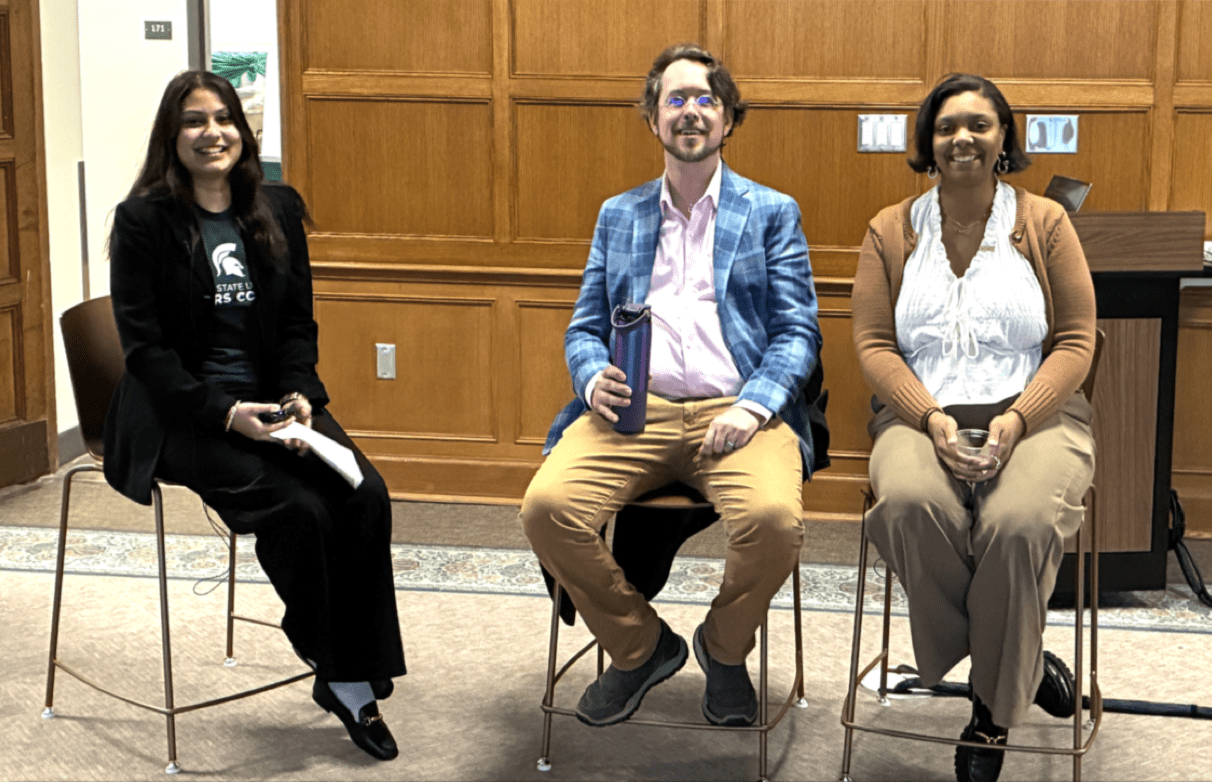
From left to right: Moderator Honors College student Sumiaya Imad, Donovan McCarty, Director, Housing Justice Clinic; Assistant Professor of Law, MSU, and Khadja Erickson, Executive Director, Mid-Michigan Tenant Resource Center; Housing Chair, NAACP Lansing Branch.
TNCPNEWS photo
By TNCPNEWS Staff
EAST LANSING, MI – Homelessness has been a hot-button issue in Ingham County. A growing tension is unfolding across Lansing and East Lansing as both cities grapple with homelessness through different approaches—one focused on regulation and the other on removal and relocation. Together, these decisions are shaping a regional pattern that raises deeper questions about housing, public space, and responsibility.
At Michigan State University Honors College’s “Decriminalizing Homelessness: Housing as a Human Right” event, speakers rooted in legal advocacy, tenant organizing, and lived experience challenged the dominant narrative that homelessness is an individual failure. The event, held at Campbell Hall, was moderated by Honors College student Sumiaya Imad.
Donovan McCarty, Director of the Housing Justice Clinic and Assistant Professor of Law at MSU, and Khadja Erickson, Executive Director of the Mid-Michigan Tenant Resource Center and Housing Chair of the NAACP Lansing Branch, both framed homelessness as a predictable outcome of policy choices, economic inequality, and systems that treat housing primarily as a commodity. The conversation called for moving away from the criminalization of poverty and toward a model of housing as a human right, grounded in justice rather than charity or punishment.
Both McCarty and Erickson began the conversation by talking about their personal histories and work. McCarty described growing up in the Detroit area and witnessing both fear of the city and the long-term devastation of housing policies like tax foreclosure, which stripped families of homes and hollowed out neighborhoods.
Erickson traced her path through her own periods of housing instability, and later working directly with people, helping them navigate unemployment and state bureaucracies during the COVID-19 crisis. These experiences, paired with exposure to Lansing’s policy machinery and Detroit’s inequitable housing landscape, pushed them into active, sustained engagement in housing justice and tenant defense.
When Survival Is Treated as a Violation
In March of 2026, the East Lansing City Council voted 4–1 to reject a proposed ordinance that would have banned camping in public spaces. The proposal, which included potential fines and jail time, drew significant opposition from residents and advocacy groups who argued it would criminalize homelessness rather than address it.
However, the council did pass a separate ordinance restricting loitering in parking structures, an action city officials say is necessary to address safety concerns and high traffic in downtown areas. Erickson argued that such ordinances target survival behaviors. Her concern is that without sufficient shelter options, restrictions simply push individuals out of sight rather than into stability.
The central theme of the MSU event was the decriminalization of homelessness. Both Erickson and McCarty spoke about how criminalization is not just about police, tickets, and courts; it is embedded in eligibility rules and programs that force people into impossible choices. For example, some rapid rehousing programs require people to be single to qualify, effectively pressuring them to break up with partners to access help.
Erickson said, “The whole spectrum of people experiencing homelessness should be able to access help, no matter how they’re existing in homelessness or what their family structure looks like. Truly equitable access means we don’t punish you for how you come to us. We take you as you are and then put you into the housing you actually need.”
She added that there are harmful myths that shape policy and public opinion. Both speakers agreed that, contrary to the stereotype of unhoused people as lazy or unwilling to work, many are working full time yet still cannot afford housing. Others are unhoused because their medical equipment cannot be accommodated in shelters, or they are young people who avoid the system out of fear of being returned to unsafe homes.
McCarty indicated that, at the same time, people cannot find housing, institutions like courts, code enforcement, and land banks can be structural drivers of displacement and act as institutional gatekeepers. Code enforcement can become an “opponent,” imposing standards that are nearly impossible to meet unless one is already well connected.
Erickson concurred, adding, “From what I’ve seen professionally, code enforcement has become an op, an opponent, for our communities. I’ve walked into properties where landlords are trying to participate in housing programs, and I honestly could not believe what was passing inspection. It feels impossible to meet the standards if you’re not already connected, and that sets people up to lose their homes.”
Clearing Encampments Without a Plan Causes More than Displacement
While the city of East Lansing debates regulation, Lansing has moved forward with enforcement actions that directly impact where unhoused residents can live. A major encampment near Dietrich Park was ordered shut down following a court ruling. The site was comprised of tents, trailers, and makeshift structures. It was a community for those with few alternatives. Some of the homes were demolished by bulldozers; for some residents, it was the only shelter they had.
Following the closure, some residents were placed in a hotel program. However, several participants were asked to leave after failing to meet program requirements, placing them back into uncertainty. This cycle, in which individuals are repeatedly uprooted without a permanent solution in place, causes stress, as each transition disrupts access to employment, health care, and documentation.
Transitional Housing, but Huge Gaps Remain
In response, Lansing is planning a 50‑unit mod pod transitional housing community designed to provide structured support, including case management and workforce services. The development is expected to move forward in 2026. Some do not like the idea of “managed homelessness.” They feel that the housing community will be a temporary, controlling environment rather than a step toward permanent housing solutions.
While these models may offer short-term relief, they also highlight a structural issue: the lack of long-term, affordable housing options that prevent homelessness in the first place.
As Lansing and East Lansing debate encampments, ordinances, and the “proper” use of public space, the core question from the Institutional Justice and Homelessness conversation remains: are we addressing homelessness itself, or simply its visibility? Clearing tents, tightening regulations, and shifting people from one block to another do not change the material conditions that keep producing homelessness—limited shelter capacity, rising housing costs, low and unstable wages, and deep gaps in mental health and support services. Policies that criminalize survival may calm public discomfort in the short term, but they leave the crisis intact. The speakers urged us to look past surface-level solutions and pay attention to the systems that shape where people can live, how they are treated, and whether they are seen as fully belonging in our communities.
Every action a city takes sends a message about who belongs, where, and under what conditions. The tenants, students, and advocates in this discussion framed that message as a matter of institutional justice: do our policies make space for disabled people, low‑wage workers, youth in crisis, and students sleeping on couches, or only for those whose struggles are easy to ignore? Conversations like this one—where lived experience, legal expertise, and community concern meet in the same room—are not a cure, but they are a necessary starting point for any honest response to homelessness. In Lansing and East Lansing, that message is still being written in council chambers, in courtrooms, in classrooms, and in the daily lives of people navigating the systems we have built.
For more information, log on to the Mid Michigan Tenant Resource Center at https://trcmm.org/